This yellow Lamborghini Aventador was sitting outside the Met Police station this morning. They have been displaying all the cars they are impounding for the past year and I think this is the nicest one so far:

This yellow Lamborghini Aventador was sitting outside the Met Police station this morning. They have been displaying all the cars they are impounding for the past year and I think this is the nicest one so far:
Posted in Random fun

I seem to have spoken to a lot of hiring managers recently who are having a bit of a time with it with members of their teams taking time off work for spurious reasons… naturally as a recruiter I sympathise and appreciate that any excuse is better than no excuse, but some really seem to take the biscuit!
Dental / GP / Hospital appointments
I’ve just had my front door kicked off its hinges
Working From Home
Amazon Delivery
Someone stole the water pipes.
Diarrhoea / last minute illness
A tragedy in the family that is so terrible its too painful to discuss any details
My train is stuck in a tunnel and I have no signal
I fell asleep / my alarm didn’t go off
I woke up feeling confused
My car broke down
My child is ill
My wife has a headache
I had a particularly bad curry last night
I normally use wash n go but today I had to use shampoo and conditioner separately so it took longer to shower this morning so I’m late.
I was abducted by the carebears.
I’m locked in my house
I was attacked last night with a machete.
UPDATE: My dog’s tail got caught in the shredder and I had to take him to the vet
Posted in Random fun, Recruitment
I’m going to pretty heavily caveat this list because I think that different skills are required for recruiters to be successful in different markets. Its also quite common for recruiters to specialise in either permanent positions or contract positions, and most recruiters will tell you that there is a big difference between the types of personality that do well in one compared to the other. Furthermore I’d say it takes a different set of skills to be successful in a growing market (eg 2003 – 2007) versus a bad a market (2010 to now).
However I think as a general rule of thumb I would look for the following factors in a recruiter I was considering working with.
A good recruiter should:
To this I would add:
Posted in Recruitment
Remember remember the fifth of November
Gunpowder, treason and plot.
I see no reason why gunpowder, treason
Should ever be forgot

This picture is of the ‘Gunpowder Plot’ conspirators: Thomas Bates, Robert Wintour, Christopher Wright, John Wright, Thomas Percy, Guy Fawkes, Robert Catesby and Thomas Wintour.
Guy Fawkes is also referred to Guido Fawkes, which is the name of a blog I like to read on a regular basis. Guido calls himself “the only man to ever enter Parliament with honest intentions”!
Posted in Uncategorized
The next QCon is scheduled for March 2013.
Tutorials are scheduled for 4th and 5th March, Conference for 6th, 7th and 8th March.
The speakers haven’t been announced yet, but if you register before 9th November you can get the early bird ticket price for £1,044… which seems pretty steep to me but I guess in the main its companies who buy the tickets for their employees, or really keen techies who can afford it. If you are neither but want to go you can actually volunteer to help and I think they’ll let you attend some days for free. Either that or there’s normally a free event or too on the last day.
Here is the LINK to the registration page.
Posted in Java
Eid Mubarak to all who are celebrating tonight and tomorrow!

Posted in Divine proportion
Since Oracle took over Java from Sun in 2009 their management of the Java software suite and custodianship of the programming language has been met with mixed reactions. About half of Java users are generally supportive and the other half seem to be critical. Traditionally the language is extended via new “versions” of the JDK and today Oracle is planning the 8th version of the Java language.
Java 8 is scheduled for release in the summer of 2013 and will include the final components of some of the features that were planned for Java 7 – namely their Rich Internet Application package “JavaFX” and “Project Coin” – and some new features such as language support for Collections and Lambda expressions.
Now it seems that Lambdas will be the interesting part. This feature is the only one of the two originally planned headline packages for Java 8 that is actually going ahead – the other being Project Jigsaw which is now planned for Java 9.
We’ll look at Lambdas in a moment, but so that you have a full overview of what we are talking about lets just look at Project Jigsaw quickly. This feature is planned to enable you to write “Modular applications” in JSE, which should make Java more scaleable and enable you to write Java applications onto small embedded devices like smart phones and tablets (I suppose to compete with Android, J2ME, Objective-C and the like). The reason for kicking this into the long grass is purportedly to ensure that version 8 is released as bug free as possible.
So on the face of it, it looks like Java 8 is going to be a bit of a damp squib. Ambitions have been scaled back and only one new feature is being released. What are they going to release that is going to be new?
Lambda expressions and PlayStation 3
Innovation in hardware has continued down the route of increasing performance by parallelizing computations across “several cores”, moving from a world of single core processors or a multi core world. Remember the fuss about Playstation 3? That was Sony’s move from a single core processor to a multi-core.
Today the corporate world of programming is starting to catch up on that technical lag and a demand has begun for a language that better utilises the performance potential of a multi-core environment.
Enter Lambda expressions and functional programming.
Lambda expressions, or anonymous functions, is a way of writing code that is functionally based. By adding Lambda expressions into the Java suite Oracle is looking to bring into their tent the functional features so far available on JVM with Scala and Clojure. Giving their clients a language platform that is more compatible than the existing JVM variants and utilises the increased performance of a multi-core environment.
Is this new?
Well it is for Oracle’s Java suite. Very new in fact. But in terms of programming, .Net adopted Lambda expressions 5 years ago in 2007 (as a feature of C# 4.0). F#, Lisp, Scala and Clojure already exist and are widely used. Oracle is actually playing catch up here, not breaking new territory.
Language vs platform
At this point it is useful to come back to the divide between the Java programming language and the Java software suite – interestingly Microsoft makes the distinction easier by calling the former C# and the latter .Net whereas with Java its just “Java”. Unlike Microsoft Java has a massive community building Open Source frameworks and features, adding a rich and sizeable driving force behind the language’s development. Oracle owns the software suite but not the language, and it’s from this Open Source space that much of the new functionality of Java has been developed. So Spring and Hibernate are both from the Open Source community, not Oracle. Since 2009 Oracle has “progressed” Java by adopting / absorbing these innovations, so EBJ3 is their version of Spring and JPA is their version of Hibernate.
So what is new with Java 8?
Developers already had access to functional features with Scala – an object oriented language with closures. And they can already write applications on embedded devices using android or J2ME or Objective-C (the point of Project Jigsaw).
Anything?
Well the Lambdas is going to be very well received by Oracle’s big corporate clients. Small companies that use Java have probably already adopted a functional language if they wanted to exploit a multi-core infrastructure, the big players however are less likely to have done so because they are much more risk adverse and for them it makes sense to wait until you get an “official” version that is supported by Oracle.
But to everybody else, Oracle is spending a lot of time and effort standardising what already exits, instead of inventing new features they are consolidating the Java position.
I think the question is not,“Can Oracle keep the Java train on the tracks?” but “Where are those tracks leading?”
By absorbing the advances made by the open source community Oracle is taking Java down a track that will eventually look like this: Oracle don’t own the Java language, but they do provide support for it. By writing each JDK they also determine what features will be compatible with “their” software platform, and it doesn’t take a genius to see that before long they can exclude Open Source features that they now have a version of (JPA and EJB3 for example) and withdraw support for technologies they don’t own. Effectively dictating what is going to be compatible with their platform and what isn’t, finally asserting the ability to control the Java world they purchased in 2009.
Fine, that’s what corporations do – make money from stuff they own – but in doing so surely they are going to push out the Open Source community which is what defines Java from C# and that has for the last 3 years been the only driving force for innovation?
Is Oracle going to crash their own train?
Not quite. I suspect that they will continue to fudge things, potentially pushing out the little companies, continuing to lose support in the OS world but ultimately not withdrawing support for the legacy JDKs because too many big companies (such as the Investment Banks) rely upon OS technologies like Spring and out-dated JDKs like 1.5 and their business is too integral to the income Oracle makes on Java. And Lambdas in Java 8 will be popular with their big fee earners. So we will see increased the capitalisation from ownership… but not world domination.
bullet (spoken)
a candidate who is such a good fit for a client that he/she is will open doors for your recruitment business, win you clients and progress to offer stage quickly and easily.
Gavin: How are you doing with that tough role you’ve got? Sandy: Don’t sweat it no more, I got a bullet
Etymology: Golden Bullet, one shot kill
See also: Golden Bullet, legend, walking invoice
Posted in Random fun, Recruitment, Speak like a recruiter
Follow this link to the Political Compass website and follow the questions to find out where your political views sit compared to modern leaders’ political beliefs. Its quite fun because rather than the usual one dimensional left / right line, it rates your views on an economic scale and a social scale. So if you believe individual property is theft and that there should be a CCTV camera on every street corner you will sit at the opposite end of the graph to someone who believes in free trade and has a live and let live approach to society.
You also get to see how your views compare to Hitler, Stalin, Margaret Thatcher and Mahatma Gandhi:

It takes about 5 minutes to get through the questions, but stick with it because its quite interesting seeing what your results are, here are mine:
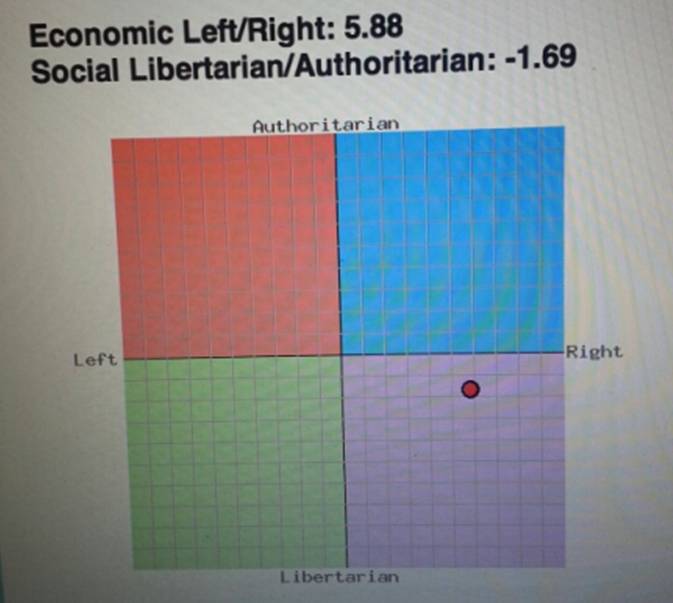
As you can see from the graph below, my political views sit no-where near any of our global leaders’ political beliefs. I don’t think that’s because my views are so unusual, I just think that most political leaders have authoritarian views because they think they know what’s better for you.

So follow the link and let me know where you come!
Posted in Random fun


 Martin Jee's blog